
The Complete Buyer’s Guide to Commercial Composting Equipment UK (2026)
Buying the right commercial composting equipment for your UK business is a significant decision. The wrong machine — wrong capacity, wrong power spec, wrong installation setup — costs you twice. This guide covers everything you need to know before you buy: what commercial composters actually do, which type suits your business, how to size correctly, what to budget, and what questions to ask any supplier.
If you have found this guide, you are probably at one of three stages. You have just received a large landfill tax bill and want to know what the alternatives are. Your Simpler Recycling compliance is due and you are weighing up a collection contract against buying your own machine. Or you have already decided you want on-site composting equipment and you want to make sure you buy the right thing.
All three are valid starting points. This guide is written for all of them. We will keep it straightforward, specific and honest — including on the things that can go wrong if you choose the wrong machine or the wrong supplier.
🌀 What Is Commercial Composting Equipment and How Does It Work?
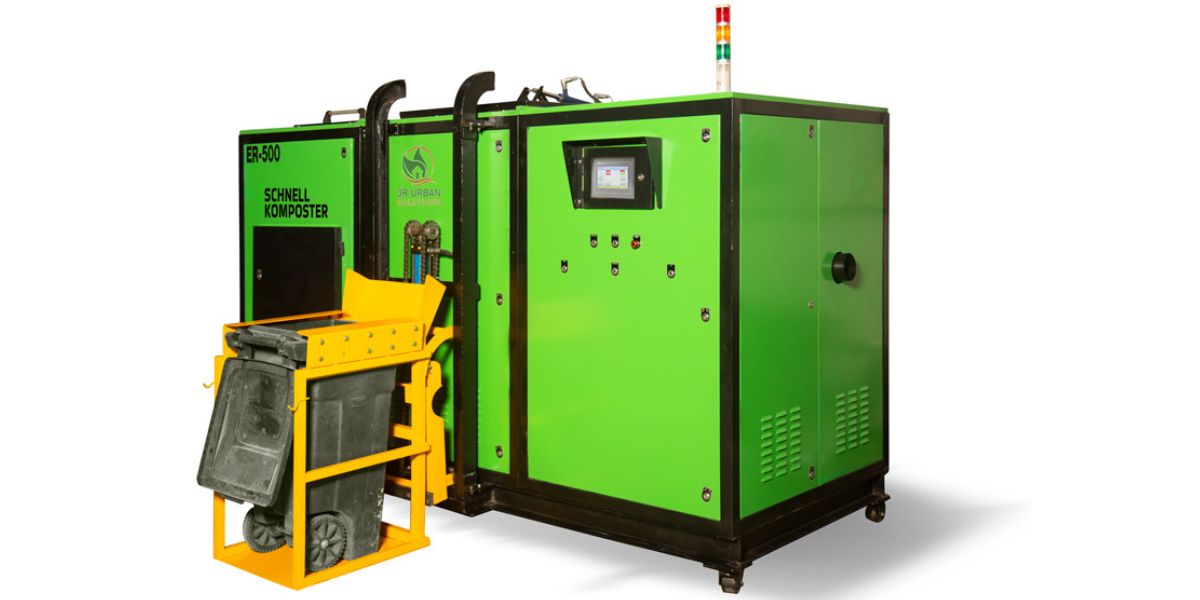
A commercial composter — also called a commercial composting machine, food waste processor or in-vessel composting unit — is a sealed, automated machine that converts food waste into compost on your premises, typically within 24 hours.
The process inside the machine is called in-vessel aerobic composting. In simple terms: food waste is loaded into a sealed, heated, rotating drum or chamber. Thermophilic bacteria — heat-tolerant microorganisms that occur naturally in organic material — break the waste down rapidly in the presence of controlled airflow. The internal temperature reaches 60–70°C, which kills pathogens and accelerates decomposition. After 24 hours, the output is stable, nutrient-rich compost.
This is fundamentally different from:
- Food waste dehydrators — which remove water from waste but do not compost it. The output is dried food waste, not compost, and cannot be used as a soil amendment. Dehydrators are sometimes marketed as composting equipment but they are not.
- Anaerobic digesters — large centralised facilities where food waste is processed without oxygen over 15–30 days, producing biogas. Not practical as on-site equipment for most commercial premises.
- Open windrow composting — outdoor piles of organic material turned periodically. Not suitable for commercial catering waste including meat and fish.
When businesses search for composting machinery UK or a commercial food waste machine, what they almost always need — and what delivers the fastest financial return — is an in-vessel aerobic composting machine. That is the only type we cover in this guide.
Important distinction: A food waste dryer is not a composter. Several products on the market are marketed ambiguously. If a machine does not reach 60–70°C internally and does not use microbial activity to break down organic matter, it is not producing compost — it is producing dried waste. Always ask for the composting methodology before purchasing.
📐 Step One: Size Your Machine Correctly — This Is the Most Important Decision
Choosing the wrong capacity is the single most common mistake when buying commercial composting equipment. An undersized machine cannot process your daily waste — overflow goes back to a collection contract, defeating the financial purpose. An oversized machine wastes capital and runs inefficiently.
The correct sizing method:
- Weigh your food waste for two representative weeks. Not an estimate — actual weights using a kitchen scale. Record daily. Calculate your average daily weight in kilograms.
- Apply the 70–75% capacity rule. Choose a machine whose rated capacity is 25–30% higher than your daily average. Running a composting machine at full rated capacity every day reduces composting effectiveness and leaves no headroom for peak days. If your average is 70 kg/day, you need the S-100 (100 kg/day rated capacity), not the S-75.
- Account for growth. If you are expanding — new restaurant covers, additional hospital wards, more school pupils — size for where you will be in 24 months, not where you are today.
| Your Daily Average | Correct Machine Size | Monthly Throughput | Typical Business Type |
|---|---|---|---|
| Up to 18 kg/day | S-25 (25 kg/day) | 0.75 t/month | Small cafe, breakfast operation |
| 18–38 kg/day | S-50 (50 kg/day) | 1.5 t/month | Small restaurant, care home |
| 38–56 kg/day | S-75 (75 kg/day) | 2.25 t/month | Restaurant 60–100 covers |
| 56–75 kg/day | S-100 (100 kg/day) | 3 t/month | Hotel to 80 rooms, secondary school |
| 75–112 kg/day | S-150 (150 kg/day) | 4.5 t/month | Hotel 80–120 rooms, NHS community |
| 112–188 kg/day | S-250 (250 kg/day) | 7.5 t/month | Large hotel, district hospital |
| 188–375 kg/day | S-500 (500 kg/day) | 15 t/month | NHS acute hospital, university |
| 375–560 kg/day | S-750 (750 kg/day) | 22.5 t/month | Large NHS Trust, large university |
| 560–750 kg/day | S-1000 (1,000 kg/day) | 30 t/month | NHS Trust campus, council hub |
| 750–1,125 kg/day | S-1500 (1,500 kg/day) | 45 t/month | Multi-site NHS network, metro council |
| Over 1,125 kg/day | S-2000 (2,000 kg/day) | 60 t/month | Largest institutional producers |
⚡ Step Two: Confirm Your Power Supply
All Schnell Komposter commercial composting equipment operates on a 415V 50Hz 3-phase power supply — the standard commercial electrical supply in UK hotels, schools, hospitals, restaurants and industrial premises. Before any machine purchase, confirm with your electrician that:
- 415V 3-phase supply is available at or near the intended installation location
- The supply has sufficient capacity for the machine’s connected load (see technical data sheet per model)
- A safety isolator switch can be installed within reach of the machine
If your premises only has single-phase supply (domestic-grade), a 3-phase supply upgrade will be needed before installation. This is straightforward for most commercial premises and your electrician can advise on cost and timeline.
📍 Step Three: Choose Your Installation Location
Good on-site composting equipment can be installed indoors or outdoors. The location needs to satisfy four requirements:
- Hard standing surface — concrete, tarmac or paving capable of bearing the machine weight (600 kg for S-25 up to 6,000 kg for S-2000)
- Access to 415V 3-phase power — within cable reach of the isolator switch
- Exhaust pipe connection — the machine exhausts warm moist air via a 3-inch or 4-inch pipe, which must connect to a nearby drainage point, downspout or up-vented PVC stack
- Clear access space — minimum 900mm on all sides for daily loading, compost collection and servicing
Common installation locations: hotel service yard or loading bay, school kitchen service area, hospital plant room or external service area, restaurant back-of-house yard, golf club outbuilding. No planning permission is required for standard installations.
💰 Step Four: Understand the Financial Case Before You Buy
The financial case for commercial composting machinery rests on two savings that begin from day one of operation:
1. Eliminated food waste collection contract costs
Whatever you currently pay a contractor to collect food waste — typically £80–£160 per tonne — disappears entirely when your food waste never leaves the site as waste.
2. Eliminated landfill tax exposure
The UK landfill tax standard rate is £126.15 per tonne in 2025–26. This is embedded in every general waste and food waste collection invoice. When food waste is composted on-site, it generates no landfill tax liability.
Combined, these two savings produce payback periods of 18–36 months for most UK businesses. Use the free ROI calculator at 3rurban.co.uk to model your specific figures in under two minutes.
The payback gets shorter every year: The landfill tax rate has risen 21.6% in a single year. Any payback calculation based on today’s rate is conservative — the real saving in years 2 and 3 will be higher as the rate continues to rise.
📋 Step Five: Understand the Regulatory Requirements
Operating commercial composting equipment on your premises requires a T23 registered environmental exemption from the Environment Agency. This is not a permit — it is a free online registration that takes approximately 30 minutes to complete. 3R Urban Solutions UK manages this on behalf of every customer as part of the standard installation service.
The T23 exemption covers:
- Up to 60 tonnes of food waste per week processed on-site (covers all 11 Schnell models)
- All catering food waste including meat, fish and dairy (Category 3 under Animal By-Products Regulation)
- Fully satisfies Simpler Recycling 2025 compliance
🔍 Ten Questions to Ask Any Commercial Composting Equipment Supplier
| Question | What a Good Answer Looks Like |
|---|---|
| Does the machine reach 60–70°C internally? | Yes — this is the temperature required for ABP Regulation compliance for meat and fish processing |
| Is this genuine composting or dehydration? | Genuine composting uses microbial activity to break down organic matter. Dehydration only removes water. |
| What power supply is required? | 415V 50Hz 3-phase for all commercial models |
| Do you manage T23 registration? | Yes — it should be included in the installation service at no extra charge |
| What is the cycle time? | 24 hours for a single processing cycle |
| Can it process meat and fish? | Yes — provided the machine reaches 60–70°C |
| What does installation include? | Delivery, positioning, electrical connection, commissioning, staff training, T23 registration, operating manual |
| What warranty is provided? | Minimum 12 months from commissioning date |
| Is after-sales support UK-based? | Yes — remote and on-site support from UK engineers |
| Can I see the financial case for my specific volumes? | Yes — a reputable supplier will produce site-specific ROI modelling before any commitment |
🌿 Ready to find the right machine for your business? 3R Urban Solutions UK provides free site assessments, financial modelling and T23 registration for every installation.