
Why On-Site Composting? The Business Case in Numbers
Food waste collection costs UK businesses an average of £180–£320 per tonne. An on-site commercial composting machine eliminates that collection entirely, turning food waste into usable compost on your premises within 24 hours.
Three forces are converging to make on-site food waste composting not just desirable but commercially necessary for UK businesses:
A typical 150 kg/day machine processing kitchen and canteen food waste can offset £15,000–£30,000 per year in collection and disposal costs at mid-range UK commercial waste rates, with the compost output usable in grounds maintenance or donated to local growing schemes.
Technology Comparison: In-Vessel vs Windrow vs Anaerobic Digestion
Not all commercial composting technologies are equal. The right choice depends on your volume, available space, end-use for the output, and regulatory obligations. Here is how the three main approaches compare.
In-vessel aerobic composting wins for volumes under 2,000 kg/day
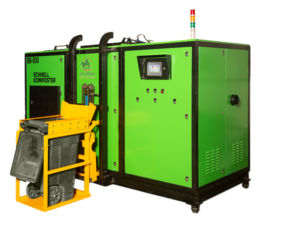
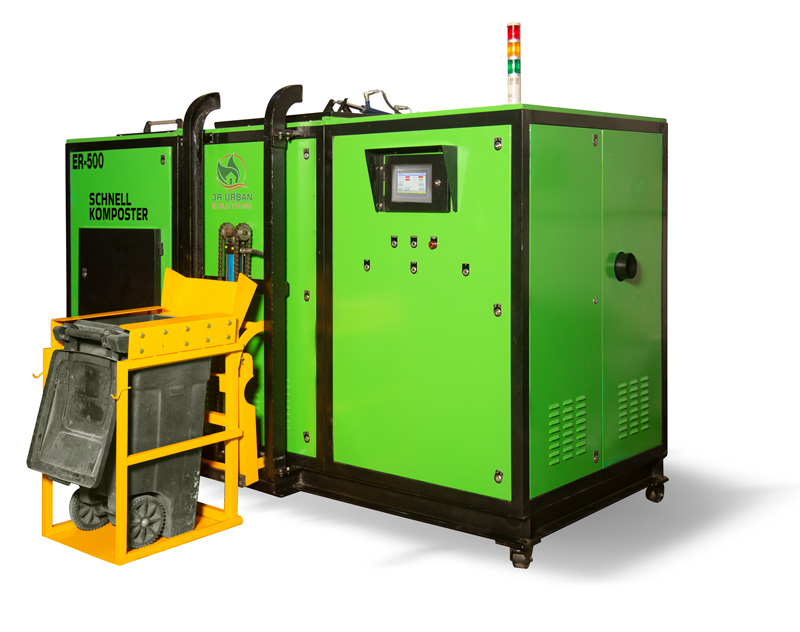
Unless you are a large-scale food processor generating 5+ tonnes per day with land for AD infrastructure, in-vessel aerobic composting offers the best combination of compact footprint, speed, odour control, meat/fish acceptance, and regulatory compliance. It is the technology used in the full Schnell Komposter range — from 25 kg/day for a small café up to 2,000 kg/day for a stadium or hospital complex.
How in-vessel aerobic composting works
The Schnell Komposter uses a horizontal drum with controlled aeration, temperature monitoring, and thermophilic bacteria to break down food waste in a single 24-hour cycle. Here is what happens inside the vessel:
Watch the full machine demonstration and processing cycle on the Schnell Komposter commercial composting machine page →
Capacity Selection Guide: Which Size Do You Need?
The single most common buyer error is under-specifying capacity. Food waste is inconsistent — events, seasonal peaks, and menu changes can double daily volumes. The rule of thumb: assess your average daily waste, then specify the next model up.
Step 1 — Calculate your daily food waste volume
Your actual daily food waste depends on your operation type and covers, not just your headcount. Use these UK benchmarks as your starting point:
| Operation type | Waste per meal cover (kg) | Example: 200 covers/day | Recommended capacity |
|---|---|---|---|
| Restaurant / bistro | 0.15–0.25 kg | 30–50 kg/day | S-50 Schnell Komposter |
| Hotel (food & bev only) | 0.20–0.35 kg | 40–70 kg/day | S-100 Schnell Komposter |
| School / university canteen | 0.10–0.18 kg | 20–36 kg/day | S-50 Schnell Komposter |
| Hospital (catering only) | 0.18–0.30 kg per bed/day | 300-bed: 54–90 kg/day | S-100 or S-150 Schnell Komposter |
| Stadium / events venue | 0.30–0.50 kg per visitor | 5,000 visitors: 1,500–2,500 kg | S-1500 or S-2000 Schnell Komposter |
| Supermarket / food retail | Varies by SKU wastage rate | 200–500 kg/day typical | S-250 or S-500 Schnell Komposter |
| Food manufacturer / processor | Process-dependent | Often 500–2,000 kg/day | S-500 to S-2000 Schnell Komposter |
| Golf club / country estate | 0.15–0.25 kg | 100 diners: 15–25 kg/day | S-25 or S-50 Schnell Komposter |
Events, functions, and busy periods can generate 2–3× your average daily waste. If your operation has predictable peaks (wedding season, Christmas, match days), size your machine to handle the peak, not the average. A machine that is overloaded loses efficiency and reduces output quality.
Step 2 — Account for input composition
Not all food waste is equal in composting terms. High-moisture items (soups, sauces, juicy fruit) require more processing time per kilogram than drier items (bread, pastry). If more than 40% of your waste is high-moisture, consider specifying one model up from the basic weight calculation.
The Schnell Komposter Range: All 11 Models at a Glance
The Schnell Komposter is manufactured to CE marking standards with 415V/50Hz/3-phase power (single-phase models available for smaller units). Every model in the range processes food waste through the same in-vessel aerobic thermophilic process — only the capacity differs.
| Model | Daily Input Capacity | Compost Output (approx.) | Footprint (L×W×H) | Power Supply | Best Suited For |
|---|---|---|---|---|---|
| Schnell Komposter S-25 Entry | 25 kg/day | 2.5–4 kg/day | ~1.2m × 0.8m × 1.1m | 240V single-phase | Small café, golf clubhouse, micro-brewery |
| Schnell Komposter S-50 | 50 kg/day | 5–7.5 kg/day | ~1.8m × 0.9m × 1.2m | 240V or 415V | Restaurant, school canteen, care home |
| Schnell Komposter S-100 | 100 kg/day | 10–15 kg/day | ~2.4m × 1.0m × 1.3m | 415V 3-phase | Hotel, secondary school, leisure centre |
| Schnell Komposter S-150 Popular | 150 kg/day | 15–22 kg/day | ~3.0m × 1.1m × 1.4m | 415V 3-phase | University canteen, district hospital, food retailer |
| Schnell Komposter S-200 | 200 kg/day | 20–30 kg/day | ~3.5m × 1.2m × 1.5m | 415V 3-phase | Large hotel, shopping centre food court |
| Schnell Komposter S-250 | 250 kg/day | 25–37 kg/day | ~4.0m × 1.2m × 1.6m | 415V 3-phase | Large food retailer, campus catering, resort hotel |
| Schnell Komposter S-500 Popular | 500 kg/day | 50–75 kg/day | ~5.5m × 1.5m × 1.8m | 415V 3-phase | Large NHS trust, food manufacturer, theme park |
| Schnell Komposter S-750 | 750 kg/day | 75–113 kg/day | ~7.0m × 1.6m × 1.9m | 415V 3-phase | Airport terminal, large sports venue, industrial kitchen |
| Schnell Komposter S-1000 | 1,000 kg/day | 100–150 kg/day | ~8.5m × 1.8m × 2.0m | 415V 3-phase | Cruise port, large NHS trust catering hub, festival site |
| Schnell Komposter S-1500 | 1,500 kg/day | 150–225 kg/day | ~10m × 2.0m × 2.2m | 415V 3-phase | Stadium, large food processing facility, army base catering |
| Schnell Komposter S-2000 Industrial | 2,000 kg/day | 200–300 kg/day | ~12m × 2.2m × 2.4m | 415V 3-phase | Major food manufacturer, hospital complex, large campus |
What Food Waste Can — and Cannot — Go Into a Commercial Composter?
One of the most common misconceptions in the market is that commercial composting machines cannot accept meat, fish, or dairy. In-vessel aerobic machines at thermophilic temperatures can and do accept these inputs safely, in compliance with ABP regulations.
- Cooked and raw meat, poultry, fish
- Dairy products (cheese, yoghurt, cream)
- Bread, pastry, cakes, biscuits
- Fruit and vegetables (cooked or raw)
- Rice, pasta, noodles
- Sauces, soups, gravies
- Eggs and eggshells
- Compostable packaging (check supplier spec)
- Coffee grounds and tea bags
- Small amounts of paper napkins
- Plastic packaging (any type)
- Metal cutlery, cans, foil
- Glass
- Large bones (can damage auger)
- Rubber or silicone items
- Conventional (non-compostable) packaging
- Chemicals, cleaning agents
- Soil or garden waste (different process)
Animal By-Products (ABP) Regulation compliance
Under UK Retained Law from EU Regulation (EC) 1069/2009, food waste from catering establishments that contains or may contain meat is classified as Category 3 Animal By-Products. Processing this waste in an in-vessel composting system must meet ABP Regulation processing standards — specifically, achieving 70°C for 60 minutes or equivalent time-temperature combinations.
The Schnell Komposter operates at 55–65°C with controlled dwell times meeting ABP Category 3 processing requirements. 3R Urban Solutions UK can provide documentation for your ABP permit application or food waste processing exemption. Ask our team for the compliance pack →
Installation Requirements, Space, and Infrastructure
Unlike windrow systems requiring acres, an in-vessel machine needs only its own footprint. But there are infrastructure requirements that need to be planned at the procurement stage — not discovered on installation day.
Models S-100 and above require a 415V / 50Hz / 3-phase supply with an isolator switch within 5 metres of the installation point. The S-25 and S-50 can run on a 240V / 32A single-phase supply. Confirm your existing supply capacity with a qualified electrician before purchase — an electrical upgrade can add £800–£3,000 to your total project cost.
All models produce a small amount of condensate (leachate) during processing. A floor drain within 2 metres or a condensate collection tray (supplied with machine) is required. The leachate volume is low — typically 2–5 litres per 100 kg of waste processed. It is diluted and can be discharged to foul drain with appropriate trade effluent consent where required.
In-vessel machines with an integrated biofilter can operate in enclosed spaces with normal HVAC. Where a biofilter is not fitted, a ventilation extract should be provided. For installation in food preparation areas, confirm odour management with your facilities team — the Schnell Komposter's sealed drum keeps odour to a minimum during normal operation.
The machine feed hopper is typically 0.8–1.1m above floor level. For large models (S-500 and above), a loading platform or forklift access for bulked waste may be appropriate. Consider the daily workflow: staff should be able to load food waste from waste bins without lifting heavy containers above shoulder height.
3R Urban Solutions UK provides a free site assessment for UK buyers, confirming electrical supply, drainage, ventilation, and access suitability before you commit to a machine size. Book your assessment →
How to Choose a Commercial Composting Machine Supplier: 9-Point Checklist
The machine is only part of the investment. The wrong supplier means a machine that underperforms, warranty claims that go unanswered, and a team that never learns to operate it effectively. Apply this checklist before signing any purchase order.
CE-marked range, UK-based support, operator training included, full ABP documentation pack, and reference sites across UK hospitality, healthcare, and education. Ask us any of these questions directly → · View the Schnell Komposter range →
Total Cost of Ownership (TCO) Calculator
The machine purchase price is only part of the story. A proper commercial decision requires understanding the 5-year total cost of ownership, set against the savings on food waste collection and disposal costs you are currently paying.
What drives the TCO equation
Beyond the headline figures, four factors materially affect your true 5-year TCO:
Commercial Composting by Sector: What Changes for Your Industry
The fundamentals are the same, but each sector has specific procurement, operational, and regulatory nuances that affect the right machine choice and supplier requirements.
Hospitals and care homes generate high-volume, consistent daily food waste from patient catering, staff canteens, and retail outlets. Key considerations: infection control protocols (machines must be cleanable to NHS standards), ABP compliance for meat-containing waste from patient meals, and procurement via NHS Supply Chain or Find a Tender.
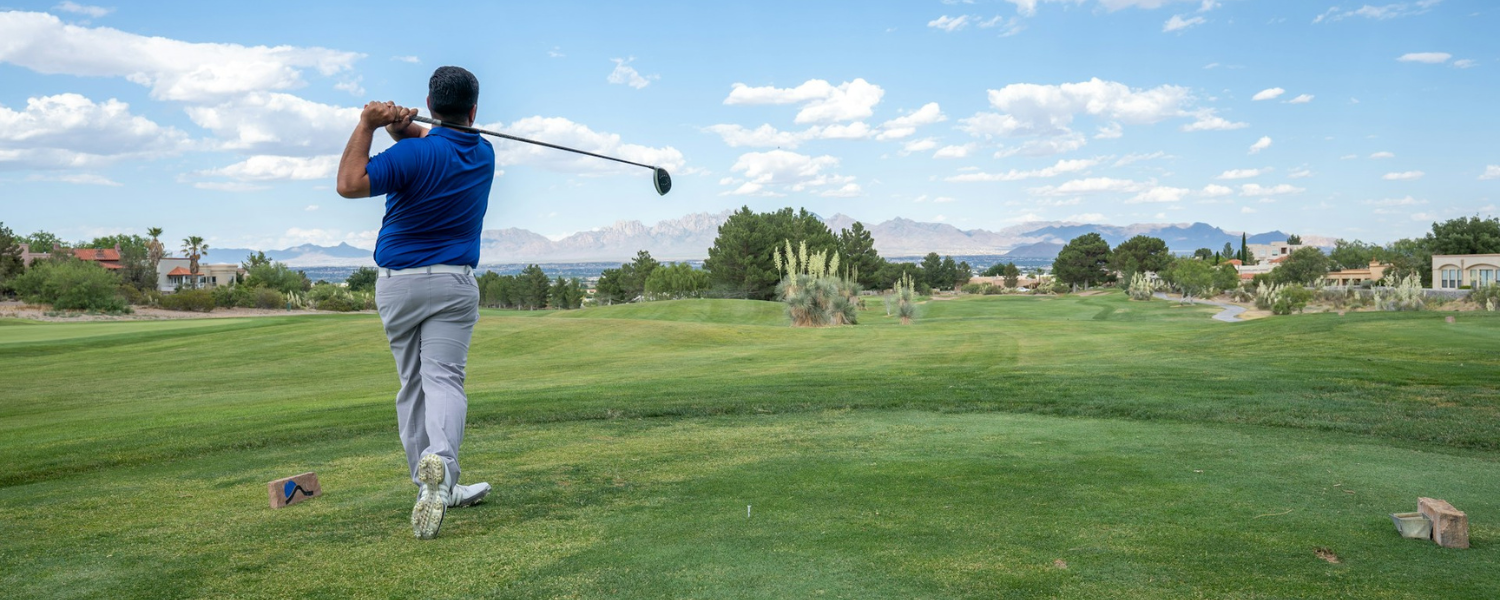
Golf clubs with catering typically generate 15–50 kg/day from the clubhouse kitchen. Smaller models (S-25, S-50) are ideal. The compost output is directly usable for the course — particularly in bunker renovation and rough-area conditioning. Sustainability credentials are increasingly relevant for club membership recruitment and green flag applications.
Hotels are among the most cost-effective composting applications due to consistent high-volume food waste from multiple revenue centres (restaurant, events, room service). A 200-room hotel with F&B typically generates 80–200 kg/day. ESG reporting to guests and corporate accounts increasingly requires documented food waste reduction data, which the Schnell Komposter provides through its operational logs.
Schools and universities benefit from both the economic and educational dimensions of on-site composting. The Simpler Recycling regulations make separate food waste collection mandatory for all educational settings with 10+ employees from 2025. University campuses with multiple catering sites often run S-100 or S-150 models in the main kitchen hub, with smaller units in residential halls.
3R Urban Solutions UK has supplied machines across hospitality, healthcare, education, food retail, and industrial clients. Describe your operation and we'll match the right model →
UK Food Waste Legislation: What Applies to Your Business in 2026
Regulatory compliance is shifting from optional to mandatory for most UK commercial food operators. Here is the current legislative landscape and what it means for your composting machine decision.
| Legislation | Who it affects | Key requirement | Deadline |
|---|---|---|---|
| Simpler Recycling (England) | All businesses with 10+ employees | Separate collection of food waste — cannot go to general waste | March 2025 (large) / April 2027 (micro) |
| Environment Act 2021 | England & Wales | Mandatory separate food waste collection from businesses; enables landfill bans | Phased 2025–2027 |
| ABP Regulation (UK retained EC 1069/2009) | Operations processing meat-containing food waste | Processing must meet time-temperature standards; permit or exemption required | Applies now |
| Waste (Scotland) Regulations 2012 | Scotland businesses >50 kg/week food waste | Separate food waste collection and reporting | Applies now — in force since 2016 |
| Circular Economy Bill (Scotland 2024) | Scotland — wider scope | Extended producer responsibility; food waste targets tightened | Implementation from 2025–2027 |
Simpler Recycling requires separate collection or treatment — not necessarily off-site collection. An approved on-site in-vessel composting machine satisfies the separate treatment requirement. This is an important distinction: a qualifying machine eliminates the need for a food waste collection contract entirely. Confirm compliance approach with your local authority or Environment Agency waste officer.
For a comprehensive overview of the regulatory landscape, see our complete UK food waste legislation compliance guide → and our food waste recycling complete guide →
Frequently Asked Questions
The questions buyers ask most before making a final decision.
3R Urban Solutions UK provides free capacity assessments, site surveys, and detailed ROI analysis for commercial buyers across the UK and Europe. Tell us your daily waste volume and operation type — we'll recommend the right model from the Schnell Komposter range and walk you through the installation requirements.